
 EN
EN
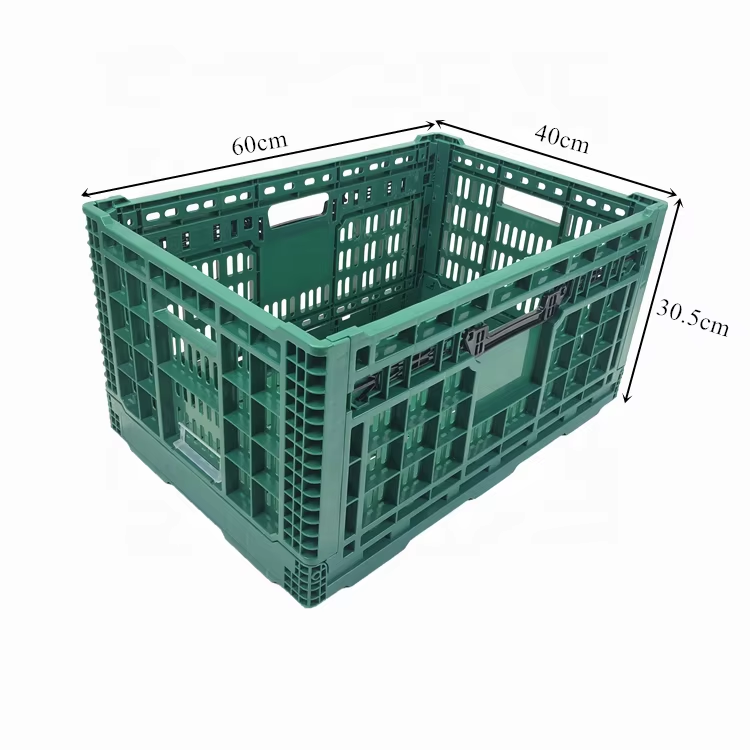
A folding crate represents one of the most practical innovations in modern logistics management, fundamentally transforming how businesses handle inventory storage and transportation. The folding crate design addresses a persistent challenge in supply chain operations: balancing the need for robust storage solutions with limited warehouse space. Unlike traditional rigid containers, a folding crate collapses when not in use, reducing storage volume by up to seventy percent and enabling companies to maximize their facility footprint. This flexibility makes the folding crate an essential tool for logistics operations seeking competitive advantage through operational efficiency.
In contemporary logistics environments, the folding crate has become indispensable for companies managing seasonal demand fluctuations, multi-site distributions, and complex reverse logistics networks. The economic and operational advantages of deploying a folding crate throughout supply chains extend far beyond simple space savings. When businesses implement folding crate solutions, they achieve measurable improvements in labor productivity, transportation costs, and inventory management accuracy. Understanding how a folding crate creates these benefits requires examining the specific operational contexts where flexibility delivers real competitive value.
How Folding Crate Design Enables Space Optimization
Collapsible Structure and Dimensional Efficiency
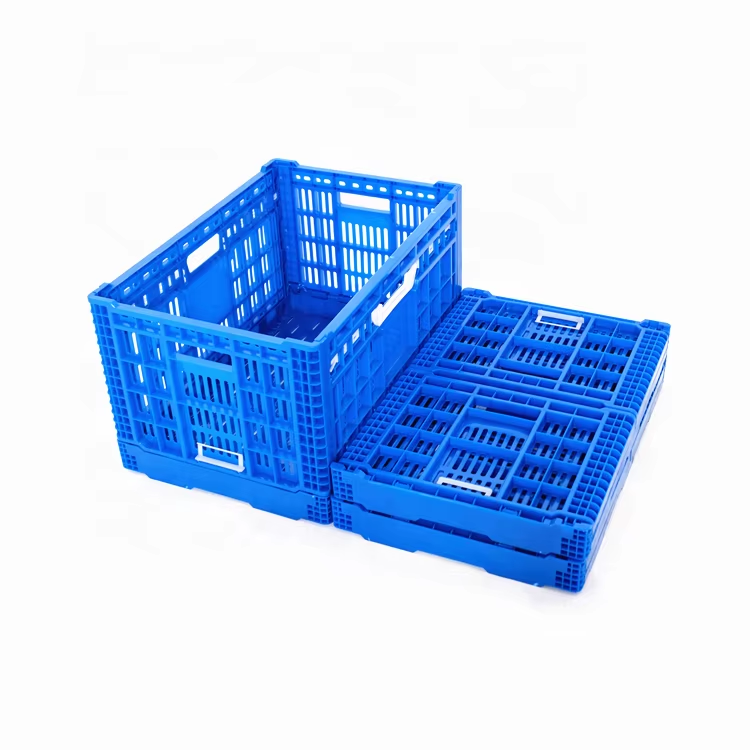
The fundamental engineering of a folding crate centers on its ability to transition between expanded storage mode and collapsed transport mode. When expanded, a folding crate maintains rigid structural integrity necessary for stacking goods safely; when collapsed, it occupies minimal vertical space in warehouses or distribution centers. This dual-state functionality means a folding crate can serve storage purposes during peak inventory periods while consuming negligible space during slower operational phases. The dimensional advantage compounds across facility networks, where dozens or hundreds of folded crates occupy shelf space equivalent to a few traditional rigid containers when stacked.
Warehouse Space Reduction and Utilization
Logistics operations continuously seek methods to expand usable storage capacity without expensive facility expansion. A folding crate directly addresses this challenge by enabling vertical stacking of collapsed units, transforming otherwise wasted corner space into productive inventory storage. When a folding crate is not actively circulating through the supply chain, it occupies roughly fifteen to twenty percent of its expanded volume. For facilities managing tens of thousands of containers, this translates to reclaiming significant square footage previously dedicated to container storage. The space reclaimed through folding crate deployment can be reallocated to inventory, order fulfillment operations, or cross-docking functions that generate direct revenue.
Cost Efficiency and Financial Impact of Folding Crate Solutions
Transportation Cost Reduction Through Volume Efficiency
The return logistics challenge represents a major expense category in supply chain budgets, particularly for perishable goods and time-sensitive products requiring rapid repositioning. A folding crate significantly reduces empty truck backhaul costs by enabling carriers to transport substantially more collapsed containers per load compared to rigid alternatives. When a folding crate collapses after product delivery, the vehicle can immediately load additional collapsed crates for return to origin facilities. This flexibility effectively doubles or triples the container throughput on return routes, improving fleet utilization rates and spreading transportation costs across greater container volumes. The financial benefits of a folding crate deployment become especially pronounced in operations with balanced outbound and return traffic.
Inventory Management and Capital Allocation
Businesses maintaining static container fleets face significant capital costs in purchasing inventory-matching quantities of rigid boxes or crates. A folding crate changes this dynamic by reducing the total container quantity required to support equivalent throughput volumes. Because a folding crate takes weeks or months to circulate versus days for rigid alternatives in certain applications, companies can operate effectively with thirty to forty percent fewer total units. The capital released from reduced container purchases can be redirected toward technology investments, facility improvements, or working capital that drives actual business growth. Additionally, a folding crate's longer serviceable lifespan relative to disposable packaging spreads its initial investment across multiple years of operational use.
Operational Flexibility and Supply Chain Responsiveness
Demand Variability and Seasonal Scaling
Agricultural products, retail goods, and consumer electronics all experience dramatic seasonal demand patterns that create intense logistics challenges. During peak seasons, a folding crate can be quickly deployed in expanded configuration to handle volume surges; during off-peak periods, the same folding crate remains stacked and stored with minimal footprint impact. This adaptability allows logistics operations to scale container capacity up or down without purchasing new equipment or storing unused inventory year-round. The operational agility provided by a folding crate makes seasonal business patterns manageable without the financial penalty of maintaining constant-level container capacity.
Multi-Site Distribution and Return Logistics Networks
Modern supply chains increasingly involve distributed warehousing, cross-dock facilities, and complex reverse logistics circuits that demand versatile container solutions. A folding crate excels in these environments because collapsed units can be efficiently positioned at locations where they will be deployed, rather than maintaining static container inventories at every site. When a folding crate arrives at a distribution center ready for product loading, it is quickly expanded and put into service; when empty, it immediately collapses for space-efficient storage or return transportation. This cycle efficiency reduces the total container inventory required across networked facilities and improves asset utilization rates throughout the entire supply chain.
FAQ
What material should a folding crate be made from for optimal durability?
A folding crate constructed from high-density polyethylene or polypropylene resin offers superior durability while maintaining the lightweight properties essential for efficient handling. These plastic materials withstand repeated collapse and expansion cycles without degradation, maintain structural integrity when stacked both expanded and collapsed, and resist damage from impacts common in logistics environments. A plastic folding crate also provides superior hygiene characteristics compared to wood alternatives, making it ideal for food, pharmaceutical, and healthcare supply chains where contamination prevention is critical.
How does a folding crate improve product protection during transport?
A folding crate's rigid expanded structure provides consistent product containment and cushioning that prevents shifting and damage during handling and transportation. Unlike flexible bags or soft packaging, a folding crate maintains fixed dimensions that integrate predictably into vehicle loading patterns and warehouse stacking schemes. The smooth interior surfaces of a folding crate reduce product abrasion, while the perforated design enables airflow that benefits temperature-sensitive items. These protective characteristics remain consistent throughout the folding crate's operational life, ensuring products experience uniform handling quality across supply chain touchpoints.
Can a folding crate work effectively in automated sorting and handling systems?
A folding crate performs well in modern automated environments because its consistent dimensions and standardized design integrate smoothly with mechanical handling equipment, conveyor systems, and robotic sorting technology. The expandable-yet-uniform structure of a folding crate allows automated systems to recognize and process containers reliably without calibration adjustments. Many facilities find that a folding crate's compatibility with automation reduces labor requirements for manual sorting and significantly improves throughput rates compared to irregular or non-standard container shapes.