
 EN
EN
The rise of automated warehouse systems has fundamentally changed how facilities think about every physical component on the floor — including the humble storage box. Far from being a passive container, a storage box today must be engineered to work in harmony with conveyors, robotic picking systems, automated guided vehicles, and warehouse management software. Understanding how this integration works is essential for any logistics professional or operations manager looking to upgrade or build out an automated facility.
The process of integrating a storage box into an automated warehouse environment goes well beyond simply choosing a container that fits on a shelf. Dimensions, material composition, structural rigidity, stacking behavior, and surface compatibility all play a critical role in determining whether a box will flow seamlessly through automated systems or create costly bottlenecks. This article breaks down exactly how a storage box functions within modern automation and what features enable that integration to succeed.
The Role of Physical Standardization in Automated Warehouses
Why Dimensional Consistency Matters
Automated warehouse systems are designed around predictability. Conveyor belts, robotic arms, sorters, and pick-and-place equipment all operate within tight tolerances. A storage box that varies even slightly in its outer dimensions from unit to unit can cause misalignment, jams, or sensor misfires. This is why standardized external measurements are one of the most important features to verify before selecting a storage box for automation integration.
Industrial plastic storage box solutions are typically manufactured with tight dimensional tolerances precisely because of this requirement. When every box on the line measures the same, the equipment can be calibrated once and perform reliably across thousands of cycles. Even a few millimeters of variation can disrupt sensor-based detection systems that rely on consistent geometry to identify the position and orientation of each container.
Standardization also allows warehouses to configure storage racks, automated retrieval systems, and sorting lanes without custom modifications. When a storage box is dimensionally uniform, the infrastructure investment is more predictable and the system as a whole becomes easier to expand or reconfigure as operational needs evolve.
Load Capacity and Structural Integrity Under Automation
Automated systems handle containers repeatedly throughout a shift, often at speeds and with forces that would never occur in a purely manual environment. A storage box used in automation must have sufficient structural integrity to survive not just the weight of its contents, but also the mechanical stresses of being gripped, lifted, moved, and deposited by robotic equipment.
Weak or flexible walls can cause a storage box to deform when gripped by a robotic arm, potentially dropping items or triggering error states in the system. Reinforced corners, consistent wall thickness, and high-quality polymer materials all contribute to a box that can withstand the repetitive mechanical engagement that defines automated handling.
Operators often overlook load capacity in the context of automation, focusing instead on static stacking performance. But dynamic load performance — how the storage box behaves when accelerating, decelerating, or being transferred between systems — is equally critical and should be evaluated before committing to a particular container design.
Stacking and Nesting Compatibility with Automated Systems
How Stacking Design Affects Robotic Handling
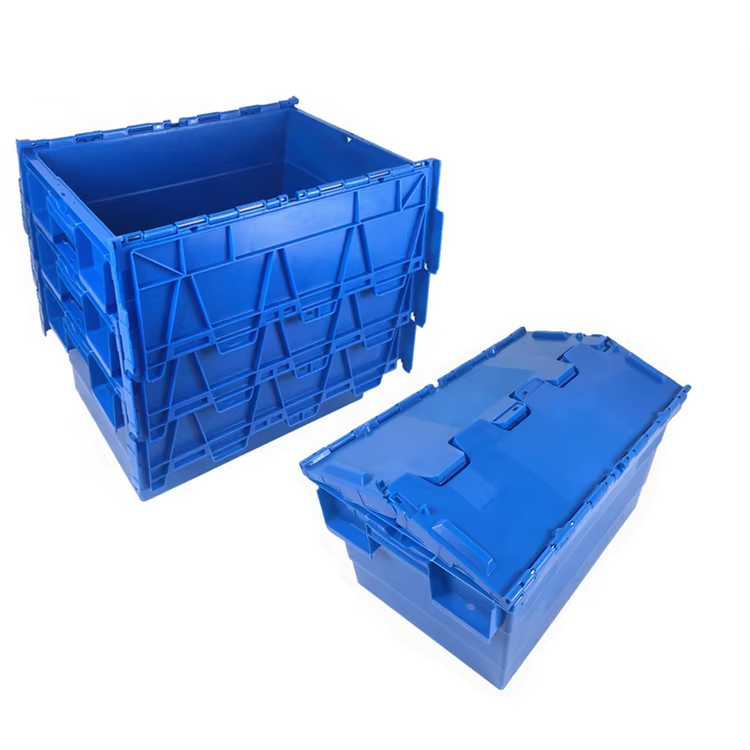
A storage box used in an automated warehouse often needs to be stackable in transit and nestable when empty, both of which must occur without manual intervention. Automated depalletizers, destacking units, and stacking robots all rely on the box having a consistent and predictable stacking interface — meaning the way the lid or rim of one box seats against the base of the next must be mechanically reliable.
Interlocking rim designs are common in industrial storage box solutions because they prevent lateral shifting during stacking operations. When robotic equipment places one box on top of another, the interlocking feature ensures the stack remains stable even through subsequent conveyor movements or vibration. Without this, stacks can shift and topple, creating safety hazards and operational shutdowns.
For empty container management — a significant but often underestimated part of warehouse operations — nesting capability allows automated systems to compress multiple empty boxes into a compact footprint. This reduces the trips required to return empties to the packing station and frees up floor space that would otherwise be consumed by bulky, non-nested containers.
Lid Integration and Secure Closure in Automated Flows
When a storage box travels through an automated system with a lid attached, the lid must remain securely closed without requiring manual fastening between each transfer point. Lids that open during conveyor transitions or robotic handoffs spill contents and disrupt automated identification systems, since barcode scanners or RFID readers may be positioned to read labels on the top or side of the box.
Snap-fit or clip-style lids are common in industrial storage box designs intended for automation. These closures can withstand the forces generated during conveyor transfers without popping open, while still being easy to remove at manual workstations where human operators need access to contents. The ability to balance automated closure security with manual accessibility is a key feature to evaluate.
It is also worth noting that lids contribute to stacking height and overall box geometry. When selecting a storage box with lid integration for an automated system, the combined dimensions of the box and lid in both open and closed configurations must be verified against the system's height and width clearances to avoid mechanical interference.
Surface and Interface Features That Enable Automation Compatibility
Barcode, RFID, and Label Surface Requirements
Modern warehouse management systems depend on accurate, high-speed identification of every storage box at multiple points in the workflow. Whether a facility uses 1D barcodes, 2D QR codes, or RFID tags, the surface of the box must support reliable reading. Highly textured, dark-colored, or curved surfaces can reduce scan accuracy and slow down automated identification processes.
Many industrial storage box designs include dedicated flat panels or recessed label areas on their exterior walls specifically to improve scan reliability. These areas provide a consistent, flat background that maximizes contrast and minimizes scan errors. RFID-compatible boxes must also be manufactured from materials that do not interfere with radio frequency transmission, which is particularly relevant for boxes stored in dense metallic racking environments.
When specifying a storage box for a new automation project, it is wise to test scan performance under actual operating conditions before full rollout. Scan rates in a lab setting may not reflect real-world performance when boxes are moving on a conveyor at full speed, so validation testing is a standard part of responsible system integration.
Base Geometry and Conveyor Surface Interaction
The underside of a storage box is in constant contact with conveyor belts, roller tracks, and automated vehicle platforms throughout its lifecycle in an automated system. The base geometry must allow smooth, consistent movement without rocking, tipping, or catching on conveyor joints. Flat, uniformly ribbed bases are generally preferred over highly irregular base geometries for this reason.
Runner rails or molded feet on the base of a storage box serve a dual purpose: they elevate the box slightly for forklift tine engagement and they provide consistent contact points on conveyor surfaces. This consistent contact geometry improves the accuracy of weight-based verification systems, which use conveyor scales to confirm that each storage box contains the expected items before it advances to the next station.
Friction characteristics of the base also influence how a storage box behaves at transfer points and divert stations. Too much friction can cause hesitation or jamming at high-speed transfer zones, while too little can result in overshooting or misalignment at sorting gates. Material selection and surface texture should be evaluated in the context of the specific conveyor system being used.
Software and Data Integration: Connecting the Physical Box to the Digital System
How WMS Software Tracks Individual Storage Boxes
A warehouse management system (WMS) does not simply track what is stored in a storage box — it tracks the box itself as a unit of inventory. Each box is assigned a unique identity, usually via a barcode or RFID tag, and the WMS records every movement, location change, and contents update associated with that box identity throughout its operational life.
This means that a storage box integrated into an automated system must have a stable, long-lasting, and machine-readable identifier attached or embedded in its structure. Labels printed on adhesive stock can peel, fade, or be damaged during handling, which is why many operations favor molded-in label recesses or embedded RFID inlays for high-frequency automated environments. The durability of the identification method must match the expected lifespan of the box itself.
When a storage box reaches the end of its serviceable life and is retired from the system, the WMS must be updated accordingly to prevent ghost inventory records from causing downstream confusion. This lifecycle management aspect is often overlooked during initial system design but becomes operationally significant in mature facilities where box fleets turn over on a rolling basis.
Automated Sorting and Zone Assignment Based on Box Identity
One of the most powerful features of modern automated warehousing is the ability to route each storage box dynamically based on its contents, destination, or priority level. When a box is scanned at an entry point, the WMS instantly calculates the optimal storage location and instructs the automated system to direct that specific box accordingly. This process happens in milliseconds and relies entirely on the box having a reliable, accurately read identifier.
Zone-based sorting is particularly important in facilities that handle temperature-sensitive goods, hazardous materials, or items with specialized handling requirements. The automated system can ensure that a storage box containing perishables is routed to a refrigerated zone while a box containing standard goods proceeds to ambient storage — all without manual decision-making by warehouse staff.
This level of intelligent routing is only possible when the physical storage box is consistently identifiable, dimensionally predictable, and mechanically compatible with the automated system's handling equipment. The physical and digital aspects of automation are inseparable, and the box sits at the intersection of both.
FAQ
What features should a storage box have to be compatible with conveyor systems?
A storage box designed for conveyor compatibility should have a flat, uniformly structured base for smooth travel, consistent external dimensions within tight tolerances, sufficient wall rigidity to withstand mechanical handling forces, and a secure lid closure system that does not open during transit. The box should also feature a flat external surface suitable for barcode or RFID reading at automated scan points along the conveyor line.
Can a standard storage box be used in an automated warehouse, or does it need to be a specialized product?
Standard consumer-grade boxes are generally not suitable for automated warehouse environments because they lack the dimensional consistency, structural strength, and identification surface features required. Industrial-grade plastic storage box solutions designed specifically for logistics and automation offer the standardized geometry, load-bearing capacity, and labeling compatibility that automated systems depend on for reliable operation.
How does a storage box with a lid perform differently from an open-top box in automated systems?
A lidded storage box offers better protection for contents during automated handling, prevents items from falling out during conveyor transfers, and allows for additional stacking height without requiring separate tray inserts. However, the lid must be designed to close securely under automated conditions and must not add unexpected variability to the box's overall height, which can affect clearance sensors and stacking robot calibration.
How often should a storage box be inspected or replaced in an automated warehouse environment?
Inspection frequency depends on the operational intensity of the facility, but a general best practice is to inspect each storage box for structural deformation, cracking, base wear, and label degradation on a periodic cycle — typically quarterly or whenever a box is flagged by automated weight or scan verification systems. Boxes that no longer meet dimensional or structural standards should be removed from service promptly to avoid downstream handling errors or system disruptions.
Table of Contents
- The Role of Physical Standardization in Automated Warehouses
- Stacking and Nesting Compatibility with Automated Systems
- Surface and Interface Features That Enable Automation Compatibility
- Software and Data Integration: Connecting the Physical Box to the Digital System
-
FAQ
- What features should a storage box have to be compatible with conveyor systems?
- Can a standard storage box be used in an automated warehouse, or does it need to be a specialized product?
- How does a storage box with a lid perform differently from an open-top box in automated systems?
- How often should a storage box be inspected or replaced in an automated warehouse environment?