
 EN
EN
When sourcing a plastic pallet for your operation, the decision goes far beyond simply choosing a load capacity or a color. Procurement teams in logistics, manufacturing, food processing, and retail distribution are increasingly recognizing that the right customization options can determine whether a plastic pallet performs reliably across its full service life or becomes a recurring cost problem. Understanding which variables actually matter during the sourcing process is essential for making a sound investment.
The global supply chain has grown more demanding, and a plastic pallet that works well in one environment may fail prematurely in another. Temperature extremes, chemical exposure, racking systems, automated handling equipment, and hygiene regulations all place different requirements on pallet design. This article examines the customization dimensions that carry the most weight when evaluating plastic pallet solutions for B2B procurement, helping buyers ask the right questions and align specifications with real operational needs.
Material Composition and Structural Grade
Choosing the Right Polymer Base
The material used to manufacture a plastic pallet is the single most consequential customization decision a buyer can make. High-density polyethylene, commonly known as HDPE, is widely used because it offers a strong balance of impact resistance, chemical compatibility, and recyclability. Polypropylene is another common choice, offering slightly higher rigidity and better performance at elevated temperatures. The choice between these materials should be driven by the specific conditions the plastic pallet will face in your facility or supply chain.
For cold chain applications, HDPE tends to maintain better impact resistance at low temperatures, reducing the risk of cracking during freezer storage or refrigerated transport. In environments where the plastic pallet will be exposed to oils, solvents, or cleaning agents, chemical compatibility charts should be reviewed carefully before finalizing material selection. Buyers who skip this step often discover incompatibility issues only after pallets have already been deployed at scale.
Some manufacturers also offer reinforced variants that incorporate fiberglass strands or steel tube inserts within the plastic pallet structure. These reinforced designs significantly increase racking capacity and reduce deflection under load, making them suitable for static racking systems where unsupported spans are longer. Understanding whether your application requires standard or reinforced construction is a foundational step in the customization process.
Virgin vs. Recycled Material Grades
Another material-level decision involves the ratio of virgin resin to recycled content. A plastic pallet made entirely from virgin resin will typically offer more consistent mechanical properties, better surface finish, and greater color uniformity. These qualities matter in food-grade environments, pharmaceutical logistics, and export applications where appearance and traceability are scrutinized.
Recycled-content plastic pallet options are increasingly available and can offer meaningful cost advantages for closed-loop internal logistics where aesthetics and traceability are less critical. However, buyers should request documentation on the recycled material source and processing standards, since inconsistent feedstock can introduce variability in load performance and surface integrity. A reputable supplier will be transparent about the material grade used in each plastic pallet product line.
Dimensional Specifications and Deck Configuration
Standard vs. Custom Footprint Sizing
Pallet dimensions are not universally standardized across all industries and regions. While formats such as 1200x1000mm and 1200x800mm are common in European logistics, North American operations frequently rely on the 48x40 inch format, and Asian markets often use 1100x1100mm configurations. When sourcing a plastic pallet for cross-border supply chains, confirming dimensional compatibility with racking systems, conveyor lines, and container loading plans is critical.
Custom footprint sizing is available from many manufacturers and becomes relevant when a plastic pallet must fit a proprietary racking system, a specialized automated storage and retrieval system, or a unique production line layout. The cost premium for non-standard dimensions is typically justified when the alternative is retrofitting equipment or accepting inefficient space utilization. Buyers should provide precise dimensional tolerances when requesting custom sizing, as even small deviations can cause handling issues in automated environments.
Deck height is another dimension that affects compatibility. A plastic pallet with a taller profile may offer better forklift entry clearance but could reduce vertical storage density in high-bay warehouses. Conversely, a low-profile plastic pallet may be preferred for automated conveyor systems where height clearance is tightly controlled. These trade-offs should be evaluated against your specific material handling infrastructure before finalizing specifications.
Deck Surface and Entry Configuration
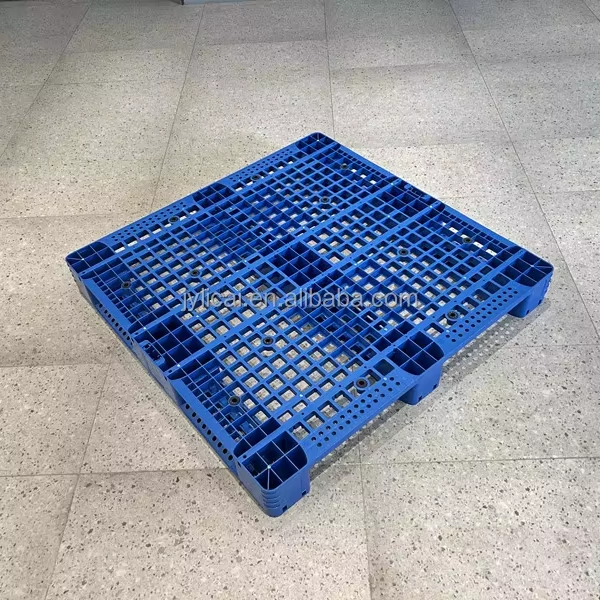
The deck surface of a plastic pallet can be configured in several ways depending on the application. A solid closed-deck surface provides maximum product support and is preferred in food processing and pharmaceutical environments where hygiene is paramount, since there are no gaps for debris or liquids to accumulate. An open-grid or perforated deck reduces weight and allows for drainage and airflow, which is advantageous in cold storage or wash-down environments.
Anti-slip surface texturing is a customization option that adds friction between the plastic pallet deck and the goods placed on it. This is particularly valuable in transport applications where vibration and movement could cause load shifting. Some buyers also specify raised edge lips or corner guards as part of the deck configuration to contain smaller items or prevent load overhang.
Entry configuration refers to whether the plastic pallet supports two-way or four-way forklift entry. Four-way entry pallets offer greater operational flexibility and are preferred in most warehouse environments. Two-way entry designs may be specified when the pallet will only be handled from fixed directions, such as on a dedicated conveyor or in a narrow-aisle racking system. Confirming entry configuration compatibility with your forklift fleet and handling equipment is a practical step that prevents costly mismatches.
Load Capacity and Racking Performance
Dynamic, Static, and Racking Load Ratings
Load capacity is one of the most frequently misunderstood specifications when sourcing a plastic pallet. There are three distinct load ratings that matter: dynamic load capacity, which applies when the plastic pallet is being moved by a forklift or pallet jack; static load capacity, which applies when the pallet is sitting on a flat floor under a stationary load; and racking load capacity, which applies when the pallet is supported only at its edges within a racking beam system.
Racking load capacity is almost always the most restrictive of the three ratings and is the one most commonly underestimated by buyers. A plastic pallet rated for 5000 kg on a flat floor may only support 1500 kg or less when placed in a racking system with a standard beam span. Buyers who source based on static or dynamic ratings alone and then deploy pallets in racking systems often experience premature deflection, structural failure, or safety incidents.
When customizing a plastic pallet for racking applications, specifying the exact beam span and load distribution pattern is essential. Reinforced plastic pallet designs with internal steel tubes or fiberglass runners are specifically engineered to address racking performance requirements. Requesting third-party test reports or manufacturer-certified load data for the specific racking configuration you use is a sound procurement practice.
Weight Optimization for Handling Efficiency
The tare weight of a plastic pallet affects handling efficiency, freight costs in export applications, and ergonomic considerations for manual handling. Lightweight plastic pallet designs using optimized rib structures and hollow sections can achieve significant weight reductions without compromising load performance. For high-volume operations where pallets are frequently repositioned manually, even a few kilograms of difference per unit can have a meaningful cumulative impact on labor efficiency and injury risk.
Buyers should request weight specifications alongside load ratings and evaluate the weight-to-capacity ratio as a performance metric. A heavier plastic pallet is not inherently stronger, and a lighter one is not inherently weaker. The structural geometry and material grade together determine performance, and modern plastic pallet engineering has made it possible to achieve high load ratings in relatively lightweight designs.
Hygiene, Compliance, and Traceability Features
Food-Grade and Pharmaceutical Compliance
Industries operating under strict hygiene regulations require a plastic pallet that meets specific material safety and cleanability standards. Food-grade plastic pallet products are manufactured from resins that comply with relevant food contact material regulations, ensuring that no harmful substances migrate into food products during storage or transport. Buyers in food processing, beverage distribution, and pharmaceutical logistics should request compliance documentation as a standard part of the sourcing process.
Surface design plays a significant role in hygiene performance. A plastic pallet with smooth, non-porous surfaces and minimal crevices is easier to clean and less likely to harbor bacteria or mold. Closed-deck designs with sealed edges are generally preferred in regulated environments. Some buyers also specify that the plastic pallet must be compatible with specific sanitization methods, such as high-pressure washing, steam cleaning, or chemical disinfection, and these requirements should be communicated clearly to the supplier.
Color coding is a practical customization option used in hygiene-sensitive environments to visually differentiate pallets used in different zones, product categories, or handling stages. A plastic pallet produced in a specific color can serve as a visual management tool that reduces cross-contamination risk and supports compliance with internal hygiene protocols. Confirming that the colorant used is food-safe and UV-stable is an important detail when specifying color for regulated applications.
RFID, Barcoding, and Asset Tracking Integration
As supply chain visibility becomes a competitive priority, many operations are integrating tracking technology directly into their plastic pallet assets. RFID tags can be embedded within the pallet structure during manufacturing, providing a durable and tamper-resistant identification solution that survives repeated handling, washing, and outdoor exposure. This approach is more reliable than adhesive labels, which can be damaged or removed during normal operations.
Barcode panels or recessed label holders can also be molded into the plastic pallet design, providing a protected surface for scannable identification labels. For operations running automated scanning systems at dock doors or conveyor checkpoints, the placement and orientation of these identification features must be specified precisely to ensure reliable read rates. Discussing tracking integration requirements with the supplier during the customization phase avoids costly retrofitting later.
Asset tracking capability transforms a plastic pallet from a passive handling tool into a data-generating supply chain asset. Operations that track pallet location, utilization rates, and cycle counts can optimize pallet pool sizes, reduce losses, and generate data that supports continuous improvement in logistics efficiency. Specifying tracking-ready features at the sourcing stage is a forward-looking investment that pays dividends as digital supply chain capabilities mature.
Color, Branding, and End-of-Life Considerations
Color Selection Beyond Aesthetics
Color is often treated as a cosmetic choice when sourcing a plastic pallet, but it carries functional and strategic significance in many operations. Beyond the hygiene zone differentiation discussed earlier, color can be used to distinguish owned pallets from pooled or rented assets, to identify pallets designated for specific customers or product lines, or to signal the age or inspection status of a pallet within a maintenance program.
UV stabilization is a relevant consideration when a plastic pallet will be used in outdoor storage or exposed to sunlight during transport. Without UV stabilizers, certain polymers will degrade and become brittle over time, reducing service life significantly. Buyers sourcing plastic pallet products for outdoor or semi-outdoor applications should confirm that UV stabilizers are included in the material formulation and request data on expected color retention and mechanical property retention under UV exposure.
Recyclability and Circular Economy Alignment
End-of-life planning is an increasingly important dimension of plastic pallet sourcing, particularly for organizations with sustainability commitments or circular economy targets. A plastic pallet manufactured from a single polymer type is significantly easier to recycle than one that combines multiple materials or incorporates metal inserts that must be separated before processing. Specifying mono-material construction where performance requirements allow it simplifies end-of-life handling and supports recyclability claims.
Some suppliers offer take-back or recycling programs for end-of-life plastic pallet units, which can support waste reduction goals and provide documentation for sustainability reporting. Buyers should inquire about these programs during the sourcing process and evaluate whether the supplier's end-of-life support aligns with their own environmental commitments. A plastic pallet that is designed for recyclability from the outset represents a more responsible long-term procurement choice.
Durability and repairability also contribute to the sustainability profile of a plastic pallet. A well-engineered plastic pallet that lasts through hundreds of cycles and can be repaired when damaged delivers a lower environmental footprint per use than a cheaper alternative that requires frequent replacement. Total cost of ownership analysis, which accounts for service life, maintenance, and end-of-life value, consistently favors higher-quality plastic pallet solutions over the long term.
FAQ
What is the most important customization factor when sourcing a plastic pallet for racking systems?
Racking load capacity is the most critical factor. Unlike static or dynamic ratings, racking capacity reflects how much weight a plastic pallet can support when held only at its edges on racking beams. Buyers should specify the exact beam span and request certified load test data for that configuration. Reinforced plastic pallet designs with internal steel or fiberglass supports are typically required for demanding racking applications.
Can a plastic pallet be customized for food-grade or pharmaceutical use?
Yes. A plastic pallet intended for food or pharmaceutical environments should be manufactured from resins that comply with applicable food contact material regulations. Closed-deck surface designs, smooth non-porous finishes, and compatibility with wash-down or steam sanitization are important hygiene-related customization options. Buyers should request compliance documentation and confirm that colorants used are also food-safe.
How does RFID integration work in a plastic pallet?
RFID tags can be embedded directly into the plastic pallet structure during the molding process, creating a durable and protected identification solution. This approach is more reliable than surface-applied labels in demanding handling environments. The tag placement must be specified to ensure compatibility with the scanning infrastructure used at dock doors, conveyor checkpoints, or warehouse management system readers.
Is a heavier plastic pallet always stronger than a lighter one?
Not necessarily. The load performance of a plastic pallet depends on its structural geometry and material grade, not simply its weight. Modern engineering techniques allow manufacturers to produce lightweight plastic pallet designs with optimized rib structures that achieve high load ratings. Buyers should evaluate the weight-to-capacity ratio and request certified load data rather than using tare weight as a proxy for strength.